News Common PC Linux Mac CUCUG
The November 21 gathering will be one of our split SIG meetings. The Linux SIG will have Angel Medina showing them the internals of computer monitors. Ed Serbe and George Krumins will be putting the X-box through its paces for the PC SIG. And, Jack Melby will be conducting a Question and Answer Session on Jaguar (Mac OS 10.2) for the Macintosh SIG meeting. Quite a varied evening.
As most of you Winsig members know, we are part of the Microsoft MindShare program. One of the nice "bennies" of this program is that we get to share in some FREE goodies from Microsoft. This month we will be holding a random drawing for (drum roll please!) Microsoft Publisher 2002! This is a very nice program for creating newsletters, sales flyers, inserts, coupon sheets--just about any printed materials you can imagine. Publisher 2002 has received high marks from reviewers and is a mature product. Amazon currently sells Publisher 2002 for $119.99--that's the equivalent of six years of CUCUG membership dues. One lucky Winsig member will walk away from Thursday's meeting with their own retail box copy of Microsoft Publisher 2002! You must be present to win, so don't miss Thursday's meeting!
WASHINGTON (AP) -- Nine of the 13 computer servers that manage global Internet traffic were crippled by a powerful electronic attack this week, officials said.
But most Internet users didn't notice because the attack only lasted an hour. Its origin was not known, and the FBI and White House were investigating.
One official described Monday's attack as the most sophisticated and large-scale assault against these crucial computers in the history of the Internet.
Seven of the 13 servers failed to respond to legitimate network traffic and two others failed intermittently during the attack, officials confirmed.
The FBI's National Infrastructure Protection Center was "aware of the denial of service attack and is addressing this matter," spokesman Steven Berry said.
Service was restored after experts enacted defensive measures and the attack suddenly stopped.
The 13 computers are spread geographically across the globe as precaution against physical disasters and operated by U.S. government agencies, universities, corporations and private organizations.
"As best we can tell, no user noticed and the attack was dealt with and life goes on," said Louis Touton, vice president for the Internet Corporation for Assigned Names and Numbers, the Internet's key governing body.
"We were prepared, we responded quickly," said Brian O'Shaughnessy, a spokesman for VeriSign Inc., which operates two of the 13 computers in northern Virginia.
Computer experts who manage some of the affected computers, speaking on condition of anonymity, said they were cooperating with the White House through its Office of Homeland Security and the President's Critical Infrastructure Protection Board.
Richard Clarke, President Bush's top cyber-security adviser and head of the protection board, has warned for months that an attack against the Internet's 13 so-called root server computers could be greatly disruptive.
These experts said the attack, which started about 4:45 p.m. EDT Monday, transmitted data to each targeted root server 30 to 40 times normal amounts. One said that just one additional failure would have disrupted e-mails and Web browsing across parts of the Internet.
Monday's attack wasn't more disruptive because many Internet providers and large corporations and organizations routinely store, or "cache," popular Web directory information for better performance.
"The Internet was designed to be able to take outages, but when you take the root servers out, you don't know how long you can work without them," said Alan Paller, director of research at the SANS Institute, a security organization based in Bethesda, Maryland.
Although the Internet theoretically can operate with only a single root server, its performance would slow if more than four root servers failed for any appreciable length of time.
In August 2000, four of the 13 root servers failed for a brief period because of a technical glitch.
A more serious problem involving root servers occurred in July 1997 after experts transferred a garbled directory list to seven root servers and failed to correct the problem for four hours. Traffic on much of the Internet ground to a halt.
Spammers have co-opted an administration feature in Microsoft's Windows operating systems and are using it to bring up intrusive advertisements on Internet-connected computers.
The feature, known as the messenger service, typically lets a network administrator send warnings to users when, for example, a server is scheduled to go down for maintenance. Now some advertisers are using it to send bulk messages to anyone connected to the Internet with an accessible address.
"Spammers are blindly sending their advertisements by randomly picking a series of Internet addresses," said Charmaine Gravning, product manager for Windows at Microsoft. "On computers without a firewall, a little messenger window pops up."
The messenger feature, not to be confused with Microsoft's instant messaging applications, can use many different protocols to send a single message, according to Microsoft. The intrusive messages only appear on computers running Windows 95, 98, NT, 2000 and XP and that are directly connected to the Internet via a valid address; Windows systems behind a firewall or attached to a router that links multiple computers to a single Internet address will be unaffected.
"The feature can be used to notify a user when a printer job fails," said Lawrence Baldwin, president of myNetWatchman.com, a company that monitors incidents on the Internet through a network of sensors set up by volunteers. "It was never the intention to let someone halfway across the world send messages that pop up on your screen."
Free utilities that enable people to exchange messages with each other using the messenger service have been available on the Internet for a while, but one enterprising company has recently started selling such software.
DirectAdvertiser.com, a U.S.-based firm registered in Romania, has created an application that lets users send advertisements via the messenger channel to anyone whose computer is set up to receive messenger-service notes. The program costs $700 and has, in two months, already sold more than 200 copies, company founder Zoltan Kovacs said in an interview.
"You always get some people who don't like the product," Kovacs said, referring to the moderate amount of critical mail he has received. "But many more are interested in the product."
Kovacs stressed in the interview and on his Web site that the application is not for sending spam. However, a testimonial on the Web site says, "If you've been a bulk e-mailer like myself, you owe it to yourself to try DirectAdvertiser."
In fact, DirectAdvertiser may be the reason more security experts have become aware of the abuse of the Windows messenger service. Students at James Madison University, for example, reported that the technique has been used to cause an ad selling university diplomas to pop up on their computer screens, according to Wired News, which first reported the abuses. Based on interviews with users of the software, MyNetWatchman.com's Baldwin estimates that spammers can send more than 100,000 messages in an hour.
"This is just going to be a whole other delivery vehicle for spam," Baldwin said, adding that the fact the service is turned on by default is another indication that Windows security has a way to go. "But welcome to Microsoft," he said.
Since a January memo sent by Microsoft chairman Bill Gates turned the company's focus to security, the software giant has been turning off unneeded services that could compromise security. While Microsoft's Gravning stressed that the firewall that ships with Windows XP disables the messenger service by default, she admitted that turning the messenger on in default installations is mainly a matter of convenience.
"Is this something that we should look at?" Gravning said. "I think that is a good question, and (I) will find out if there is a reason that we have it turned on."
LONDON (Reuters) - CD-recording software maker Roxio Inc emerged as the potential new owner of Napster (news - web sites) on Friday, bidding to buy the revolutionary song-swapping site for $5.3 million in cash and stock.
The Nasdaq-listed firm filed an offer to a Wilmington, Delaware bankruptcy court on Thursday to purchase Napster's assets for $5 million in cash and 100,000 warrants for Roxio stock. Roxio's shares ended Thursday's session at $3.38.
The deal hinges upon approval by the bankruptcy court, which has been overseeing the sale of Napster's assets since the track-trading service filed for Chapter 11 protection in September.
A spokesman for Roxio in London said the company came to an agreement with creditors and a court-appointed trustee overseeing Napster's reorganization following a series of negotiations.
More than a dozen bidders, including Barcelona-based adult entertainment company Private Media Group, have emerged as possible buyers of Napster's assets.
Rival bidders have until November 27, the date the court is expected to rule on the offer, to top the Roxio bid, the spokesman said.
NOT FREE, BUT CHEAP
The Roxio offer price is considered relatively cheap for a song-swapping service that in its heyday attracted tens of millions of young music fans, a group highly desirable to record labels looking to cultivate a loyal following.
Trenwith Securities, the U.S. investment firm handling the Napster asset sale, originally asked that offers for Napster's revolutionary technology begin at $6 million.
With the exception of Private's $2.4 million all-stock bid, none of the offers, nor the identities of the bidders, have been made public.
Microsoft has issued security updates for Macintosh versions of Office 98 (1.5 MB), Office 2001 (2 MB), and Office X (2.8 MB). The updates correct two security issues, one where a holder of a valid security certificate could generate bogus subordinate certificates which Office would believe to be valid (Microsoft security bulletin MS02-050), and another where field codes in Microsoft Word could be used to gather information surreptitiously from users' documents in some circumstances (Microsoft security bulletin MS02-059). The security certificate problem is the same one for which Microsoft released new versions of Internet Explorer last month.
http://www.microsoft.com/mac/download/security.asp
http://www.microsoft.com/technet/treeview/?url=/technet/security/bulletin/MS02-050.asp
http://www.microsoft.com/technet/treeview/?url=/technet/security/bulletin/MS02-059.asp
http://db.tidbits.com/getbits.acgi?tbart=06947
Significantly, the security update for Office X also includes unspecified improvements which may improve application stability under Jaguar, welcome news for frustrated users of Word X who have experienced inordinate program crashes since upgrading to Jaguar. [GD]
Apple Computer last week announced a net loss of $45 million for its fourth fiscal quarter of 2002, although Apple's net numbers for the entire fiscal year were positive, with $65 million in earnings on $5.74 billion in revenue. The fourth quarter results included several non-recurring items (including write-downs of investments); without these items, Apple would have had a net profit of $7 million for the quarter. Revenues for the quarter were $1.44 billion, and gross margins were down to 26.4 percent from 30.1 percent in the same fiscal quarter of 2001. Curiously, international sales accounted for only 35 percent of Apple's revenue: usually, international sales contribute just under half of Apple's revenue.
http://www.apple.com/pr/library/2002/oct/16earnings.html
Apple said it does not expect the computer industry as a whole to improve soon, so the company does not anticipate a dramatic uptick in profits. However, Apple hopes to do well during the holiday season with consumer-oriented items like iPods, iMacs, and iBooks, and the company claims Mac OS X 10.2 is on track to have 5 million users by the end of the calendar year. Apple retail stores had 2.25 million visitors during the last quarter, and Apple as a whole remains in good financial shape with more than $4.3 billion in cash on hand, no revenue slippage, and normal levels of channel inventory. [GD]
Apple has unveiled "X for Teachers," a new program offering _free_ not-for-resale copies of Mac OS X 10.2 Jaguar for eligible K-12 teachers in the U.S. (and, after 24-Oct-02, in Canada) for their personal, educational, and/or research use. The package will feature a "Getting Started with Mac OS X" self-paced training CD-ROM that presumably introduces Mac OS X's key features; also included are Apple's digital hub applications iMovie, iTunes, and iPhoto.
http://www.apple.com/education/macosxforteachers/
http://www.apple.com/ca/education/macosxforteachers/
http://www.apple.com/macosx/
To qualify, teachers must be currently employed as a K-12 teacher in a public, private, or charter school. Non-teacher school employees, student teachers, higher education faculty, home schools, resellers, and others are not eligible, and there's a limit of one copy of Jaguar per qualifying teacher. Orders must be placed via the X for Teachers Web pages, and orders will be shipped to the teachers' school addresses. The X for Teachers program runs through 31-Dec-02. [GD]
Apple has released the iMac SuperDrive Update, the first of a series of SuperDrive firmware updates that are critical for owners of SuperDrive-equipped Macs. A bug in the firmware of Pioneer DVD-writing drives (such as the SuperDrive, though Apple doesn't use Pioneer drives exclusively) makes them unable to identify media belonging to a new specification for higher-speed DVD media. Using these discs, which record at 4x speed for DVD-R and 2x for DVD-RW, can potentially damage the drive itself: the device's laser attempts to determine what type of media has been inserted, and since it doesn't recognize the new format, it keeps trying until it overheats and burns out. (Macintosh author Jim Heid has published more detailed information at his Macintosh Digital Hub Web site.) So far, Apple has released an update only for the iMac G4 (15-inch Flat Panel), and only under Mac OS X; the company says that updates for the Power Mac G4, as well as Mac OS 9 versions for both types of machine, will be posted soon. Recent models, such as the 17-inch iMac G4, the SuperDrive-equipped eMac, and the Power Mac G4 (Mirrored Drive Doors), include the latest firmware version and are not affected by the problem. The iMac SuperDrive Update for Mac OS X is a 1.2 MB download. [JLC]
http://www.apple.com/hardware/superdrive/
http://www.macintoshdigitalhub.com/superdrive/
Soon after introducing a new StuffIt compression format, Aladdin has released an update to its system-wide utility for compressing and expanding files. StuffIt Deluxe 7.0.1 improves compatibility with Mac OS X 10.2, speeds up the Fast Compression option of the new StuffIt X file format, and adds support for Finder command keys while using the Dvorak key layout. The utility also adds support for Intego's VirusBarrier. The StuffIt Deluxe 7.0.1 updater is free for registered users and is a 7.9 MB download for the Mac OS X version, or a 2.8 MB download for those running Mac OS 8.6 through Mac OS 9.
http://www.stuffit.com/stuffit/deluxe/updates.html
http://www.virusbarrier.com/virusbarrier/
Aladdin also recently released StuffIt Expander 7.0, part of the StuffIt Standard Edition package (formerly known as StuffIt Light). Due to a security vulnerability discovered in StuffIt Expander 6.52 and earlier, Apple offers StuffIt Expander 7.0 by itself via Software Update. [JLC]
http://www.kb.cert.org/vuls/id/383779
In "Update Firmware Before Installing Jaguar!" in TidBITS-653_ we outlined an arduous hard drive-swapping process to recover iMacs that had been rendered unusable by installing Mac OS X 10.2 Jaguar. If an affected iMac has a VGA video output port, an easier option may be to connect it to an external VGA monitor. If the external monitor mirrors your iMac's display, you should be able to update the system's firmware directly without attempting to dismantle your iMac... or paying for a motherboard replacement. [GD]
http://db.tidbits.com/getbits.acgi?tbart=06973
http://db.tidbits.com/getbits.acgi?tlkthrd=1783
Apple released the Mac OS X 10.2.2 update via Software Update late today, rolling in a number of bug fixes, improvements for both Apple's built-in programs and third- party applications, networking enhancements, and enhanced compatibility with other devices. (Apple's KnowledgeBase article includes a list of specific items addressed). The 24.4 MB update is for moving from Mac OS X 10.2.1 to 10.2.2; a separate combo updater is also available for those updating from 10.2 (though at press time, neither standalone updater was available from Apple's software downloads page). [JLC]
http://docs.info.apple.com/article.html?artnum=107140
http://docs.info.apple.com/article.html?artnum=107141
http://www.info.apple.com/support/downloads.html
Apple has posted an important update for owners of older SuperDrive-equipped Power Mac G4 computers (specifically, the Digital Audio, Quicksilver, or Quicksilver 2002 models, but not the Mirrored Drive Doors model, to use Apple's insipid model identification scheme). The Power Mac G4 SuperDrive Update corrects a problem in the drive's firmware that could cause the drive to overheat when using new 4x speed DVD media (for more details, see "Apple Posts Important iMac SuperDrive Update" in TidBITS-653_). The update is currently available only under Mac OS X; Mac OS 9 versions will be posted shortly, according to Apple. [JLC]
http://www.apple.com/hardware/superdrive/
http://docs.info.apple.com/article.html?artnum=120166
http://db.tidbits.com/getbits.acgi?tbart=06969
Just in time for the holiday feeding frenzy, Apple has updated the Titanium PowerBook G4 and iBook lines. The PowerBook G4 now offers either a Combo DVD-ROM/CD-RW drive or the first slot-loading SuperDrive (DVD- R/CD-RW), the ATI Mobility Radeon 9000 graphics processor, and a PowerPC G4 processor running at either 867 MHz or 1 GHz. The top-of-the-line 1 GHz model includes the SuperDrive and an AirPort card, along with 512 MB of RAM, a 60 GB hard drive, and 64 MB of DDR SDRAM graphics memory for $3,000, whereas the 867 MHz model drops the price to $2,300 by using a Combo drive, making the AirPort card optional, and shipping with only 256 MB of RAM, a 40 GB hard drive, and only 32 MB of DDR SDRAM graphics memory. Although it's interesting that Apple is now making the AirPort card standard equipment, Apple made no comment about improving the Titanium PowerBook G4's abysmal range with wireless networks. Nonetheless, the enhancements to the 1 GHz model should make it an even more attractive option for those who want to work only on a laptop without giving up options like the SuperDrive that were previously available only in desktop Macs. The 867 MHz model is available immediately; the 1 GHz model should be available in mid-November.
http://www.apple.com/powerbook/
http://www.apple.com/pr/library/2002/nov/06pbg4.html
The changes to the iBook are less significant, though certainly welcome. Apple has increased processor speeds, so you can buy iBooks with either 700 MHz or 800 MHz PowerPC G3 processors, and the company also added the ATI Mobility Radeon 7500 graphics controller, with either 16 MB or 32 MB of RAM. Prices have dropped as well, so an iBook with the smaller 12.1-inch screen, a 700 MHz PowerPC G3, 128 MB of RAM, a 20 GB hard drive, and a CD-ROM drive costs only $1,000. Add $300 for the next model up, which offers an 800 MHz PowerPC G3, a 30 GB hard drive, and a Combo drive. The larger 14.1-inch screen model costs $1,600, but provides an 800 MHz PowerPC G3, 256 MB of RAM, a 30 GB hard drive, and a Combo drive. AirPort cards can be added to any of the iBook models. All models of the iBook are available immediately. [ACE]
http://www.apple.com/ibook/
http://www.apple.com/pr/library/2002/nov/06ibook.html
Qualcomm has released Eudora 5.2, the latest version of their popular email
program. The most important and welcome feature is that Eudora filters can
now match addresses in incoming messages against the contents of address
books; this lets you separate mail from people already in your address book
from those with whom you haven't already corresponded, like spammers. The
other major improvements relate to security; Eudora now supports Kerberos V
Authentication, and the SSL support previously available under Mac OS 9
returns for users of Mac OS X 10.2. Eudora 5.2 also includes numerous other
small changes and bug fixes, such as improved performance opening many
windows, a help button added to all error dialogs and standard alerts,
support for drag & drop to and from the Filters window,
personality-specific x-eudora-settings (I've updated the full list of
settings for 5.2; send email to
http://www.eudora.com/
On Friday, 01-Nov-02, the four year-old antitrust case brought by the U.S.
Department of Justice and 18 states and the District of Columbia drew to a
close with a ruling by U.S. District Court Judge Colleen Kollar-Kotelly.
Judge Kollar-Kotelly essentially accepted the proposed settlement between
Microsoft and the Justice Department and nine states, making relatively few
substantive changes. Unless they challenge it on appeal, her decision also
ends the effort by the states dissenting from the original proposed
settlement. (See our article series tracking the progress of the
long-running case.)
http://db.tidbits.com/getbits.acgi?tbser=1152
In reading Judge Kollar-Kotelly's opinion, I was struck by three things:
Let's skim through the final judgment. You can read the entire
document and Judge Kollar-Kotelly's 101-page opinion (prefixed
with her comments about the dissenting states) here:
http://www.dcd.uscourts.gov/FinalDecree.pdf
Anti-Retaliation
A number of clauses prevent Microsoft from retaliating against or
threatening retaliation against an OEM (Original Equipment Manufacturer) if
the OEM is developing, distributing, promoting, using, selling, or
licensing any software that competes with Windows or any Microsoft
middleware product. (Middleware is software that other developers can use
to run applications and that could easily be ported to other operating
systems; examples are Web browsers and Java virtual machines.)
Also protected from retaliation or threat of retaliation is the act of
shipping a PC that either includes both Windows and another non-Microsoft
operating system, or can boot with more than one operating system. This
last part ensures Microsoft cannot prevent OEMs from selling PCs with Linux
pre-installed or as an option.
Along with OEMs, independent software vendors (ISVs) gain protection from
Microsoft retaliation or threat of retaliation, either for developing,
using, distributing, promoting, or supporting any software that competes
with Windows or Microsoft middleware. Plus, Microsoft may not enter into
agreements that require an ISV refrain from developing, using,
distributing, or promoting competing software.
(Judge Kollar-Kotelly added the bit about threatening retaliation to the
language in the proposed settlement because she felt that was a significant
concern, despite the government's claim that banning the act of retaliation
itself was sufficient.)
As a variant on the protection, Microsoft may not enter into agreements
that require a company to distribute, promote, use, or support Windows or
Microsoft middleware exclusively or in some fixed percentage, unless the
company in question can practically provide equal time to a competing
product. Apple falls into this category because of the 1997 agreement in
which Microsoft agreed to keep working on Microsoft Office in exchange for
Apple making Internet Explorer the default browser, avoiding Netscape
Navigator, and not promoting other Web browsers. That sort of agreement
would now violate the terms of the settlement. (One limitation on this
restriction: it doesn't apply if Microsoft licenses intellectual property
from the third party and if the intellectual property license is the
primary purpose of the agreement. This latter clause was Judge
Kollar-Kotelly's addition; she didn't want every agreement to turn into a
sham intellectual property license.)
Uniform Licenses
This provision in the settlement requires that Microsoft issue uniform
licenses to OEMs licensing Windows. In essence, this clause ensures a fair
playing field for licensing Windows, although there are several exceptions
for different language versions of Windows, for volume discounts, and for
various marketing-related discounts (as long they're distributed uniformly
to OEMs of varying sizes).
Judge Kollar-Kotelly took slight exception with this section because she
felt that uniformity wasn't necessarily in the best interests of all
licensees, and presumably, the public. However her concerns weren't
sufficient to suggest an alternative.
Flexible OEM Licenses
Many of the complaints about Microsoft stemmed from the company's
restriction of how OEMs could modify the look of Windows. The settlement
addresses this by forcing Microsoft to allow OEMs to:
API & Communication Protocol Disclosure
To prevent Microsoft from taking advantage of private APIs in its
middleware products, the settlement requires Microsoft to disclose the APIs
(Application Programming Interfaces; the hooks applications use to connect
to middleware or an operating system). Plus, Microsoft must also make
available, via reasonable and non-discriminatory licensing terms, the
communication protocols used by any product Microsoft installs with Windows
and that communicates with a Microsoft server operating system, such as
Windows 2000.
In this section, Judge Kollar-Kotelly made one significant change by
reducing the time before which these disclosures must be made to three
months, down from twelve months and nine months, for the API disclosures
and the communication protocol disclosures, respectively.
Some of the feedback to the court about the proposed settlement argued that
Microsoft must issue royalty-free licenses for these communication
protocols; in her opinion, Judge Kollar-Kotelly disagreed, saying that
Microsoft's liability didn't require it to give away significant amounts of
valuable intellectual property rights.
There is one significant limitation to this requirement that Microsoft
disclose APIs and license communication protocols. Microsoft does not have
to reveal anything that would compromise anti-piracy, anti-virus, software
licensing, digital rights management, encryption, or authentication
systems. Similarly, Microsoft can make licenses related to these type of
systems conditional on the licensee having no history of software piracy or
willful violation of intellectual property rights, having a reasonable
business need, meeting reasonable standards for verification of the
authenticity and viability of its business, and agreeing to submit the
related software to third-party certification of specification compliance.
End User Control
In an attempt to give end users more control over their computing
environments, the settlement requires Microsoft to allow end users and OEMs
to enable or remove access to Microsoft or non-Microsoft middleware through
icons, shortcuts, and menu entries, and by controlling automatic launching.
Plus, end users and OEMs may designate non-Microsoft middleware to replace
Microsoft middleware.
Similarly, Windows itself may not automatically alter the OEM's
configuration of icons, shortcuts, and menu entries without asking for
confirmation from the user. That confirmation cannot happen until 14 days
after the first time the user turns on a new computer, and any such
automatic removal must include both Microsoft and non-Microsoft products.
This particular section is aimed at protecting the Windows Desktop Cleanup
Wizard, which removes unused icons from the desktop.
RAND Licensing of Microsoft IP
If intellectual property licenses are required for a company to exercise
the options provided in the settlement, Microsoft must license that
intellectual property using reasonable and non-discriminatory (RAND) terms.
The licenses can be narrow in scope and may be non-transferable, but Judge
Kollar-Kotelly struck without comment a clause that would have required the
third-parties to license back to Microsoft certain intellectual property
rights related to the exercising of these options.
Compliance & Enforcement
Perhaps the most significant change Judge Kollar-Kotelly made is in the
Compliance and Enforcement Procedures section. Initially Microsoft and the
Justice Department had proposed a Technical Committee of three independent
people, one appointed by each side and the first two selecting the third.
Though it's difficult to see what concern Judge Kollar-Kotelly had with
this proposal, in the final judgment she replaced the Technical Committee
with a Compliance Committee made up of at least three members of the
Microsoft Board of Directors who are not present or former employees of
Microsoft. This approach maps the method proposed by the dissenting states,
so it's possible she adopted it to throw them a bone.
A major aspect of compliance is a Compliance Officer appointed by the
Compliance Committee. The Compliance Officer's duties include distributing
and explaining the settlement to all Microsoft officers and directors,
providing annual briefings on the settlement, tracking Microsoft's
compliance, certifying annually to the plaintiffs that Microsoft has
remained in compliance, and reporting any violations to the plaintiffs.
Enforcement authority remains with the plaintiffs, and includes the states.
For coordination, the plaintiff states must form an enforcement committee,
and no individual state may take action without first consulting the
enforcement committee. Jurisdiction and power to issue further orders or
directions remains with the U.S. District Court for the District of
Columbia; something about which Judge Kollar-Kotelly felt strongly, so much
so that she made it explicit in the final judgment.
Next Update in Five Years
Although most antitrust decisions remain in place for at least ten years,
the settlement calls for termination after only five years due to the fast
pace of the industry. However, the plaintiffs can apply to the court for a
one-time extension of up to two years if Microsoft has engaged in a pattern
of willful and systematic violations.
The final judgment is certainly far weaker than the dissenting states had
proposed and hoped for, but in essence, they set their sights too high, and
received almost nothing they wanted. The judgment is thus widely seen as a
victory for Microsoft, which had faced the possibility of a breakup. The
remedies, though arguably an appropriate attempt to terminate the illegal
maintenance of Microsoft's monopoly, are unlikely to slow Microsoft down
much at all. Whether or not other companies are able to compete with the
Microsoft juggernaut even after these remedies are in place remains to be
seen.
But Judge Kollar-Kotelly will be watching to make sure the playing field
remains level; at the very end of her full 344- page discussion, she quoted
Machiavelli in saying, "Let it not be said of Microsoft that 'a prince
never lacks legitimate reasons to break his promise,' for this Court will
exercise its full panoply of powers to ensure that the letter and the
spirit of this remedial decree are carried out."
http://www.dcd.uscourts.gov/Lit11-1.pdf
The Beast has hired a research crew to do a bit of attitude sampling among
the Great Unwashed in the US and abroad, and has found that slagging Linux
is not winning it any points. In a company memo posted by Eric S. Raymond
here (http://www.opensource.org/halloween/halloween7.php) we learn that
regular folks are both eager for a Microsoft alternative and generally
respectful of the open-source concept.
We also learn that bombastic hoots by Steve Ballmer likening the GPL to a
virus are in fact offensive to many people. Outright lies, like Ballmer's
claim that Windows is, overall, cheaper than Linux also haven't been
playing well, the researchers discovered.
"A plurality (40%) of all respondents felt that a low TCO [total cost of
ownership] was the best reason to support OSS [open source software], the
report says. MS does make much about the fact that running *nix requires a
bit of expertise, whereas dumber, hence cheaper, employees can manage a
Windows system. On the other hand they've got a license that just keeps on
taking, so it's hard to believe that after a couple of years the Redmond
crack addiction isn't going to start upsetting the economic tables to MS'
advantage.
Additionally, we're told that "one-third of all respondents cited 'an
alternative to Microsoft' as one of the best reasons to support OSS."
Apparently a lot of people are starting to question the wisdom of a
computing monoculture, as they should.
Most interestingly, "messages that criticize OSS, Linux, & the GPL are NOT
effective," the survey crew has learned. (emphasis original)
"On the other hand, 'positive' OSS, Linux, and GPL messages are very
effective -- both across geographies and audiences."
What this might mean we're almost afraid to ask. But apparently we can
expect Ballmer to start waxing sentimental about how wonderful Linux and
the GPl are, second only to Windows and the license that keeps on taking.
"In the short term, then, Microsoft should avoid criticizing OSS and Linux
directly, continue to develop and aim to eventually win the TCO argument."
I have no idea what this means but I can hardly wait to find out. I
seriously doubt that the TCO argument can be won without frequent recourse
to outrageous lies and strident insistence that black is white and up is
down. But then this is the sort of gravity-defying rhetoric at which the
Redmond PR machine excels, so all bets are off.
One of the goals of the survey was to compare reactions to open-source
software and Microsoft's self-serving substitute with strings,
'shared-source' software. There's a fair bit of tortured rhetoric involved,
but the wind-up is that SSS could probably fly so long as it's adequately
misrepresented. Traditionally cynical Europeans and Asians are unlikely to
be fooled, the survey notes, but Americans won't be much trouble, having
always been easy, willing prey for commercial manipulators and
propagandists.
"Overall, the greatest challenges we face are with the International
audience -- especially the French, Germans, and Japanese," the memo
laments.
But they've still got the Americans by the short and curlies: "support for
Shared Source was strongest in the US (73%)," the writers were relieved to
say.
Of course that number is certain to change as the details become better
known.
People accuse Microsoft of devious tactics all the time. Microsoft
generally denies the accusations -- after all, they're flanked by the best
lawyers that money can buy.
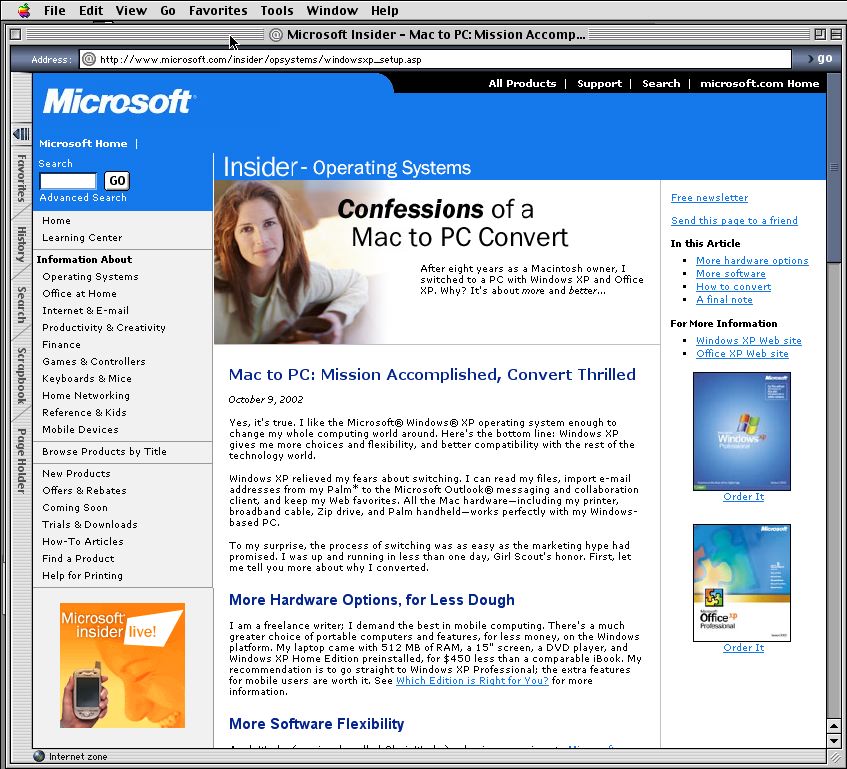
This week, though, Microsoft gave itself a big, goopy pie in the face. On
Oct. 9, the company posted a testimonial on its Web site called
"Confessions of a Mac to PC Convert." It was a first-person account by a
"freelance writer" about how she had fallen in love with Windows XP. She
compared the operating system to a Lexus. "I was up and running in less
than one day, Girl Scout's honor," burbled the attractive, 20-something
brunette in the photo.
There was only one problem: She doesn't exist.
A with-it member of Slashdot.org, the popular hangout for articulate nerds,
happened to notice that the woman's picture actually came from
GettyImages.com, a stock-photo agency. Associated Press reporter Ted Bridis
took it from there. He tracked authorship of the article to one Valerie
Mallinson, a public-relations woman hired by Microsoft to write the story.
Microsoft was caught red-handed.
I was dying to find out how this public-relations fiasco came to pass, but
Microsoft spokesman Tom Pilla would speak only in Officialese. "The article
was mistakenly posted to the Microsoft Web Site," is all he would tell me.
"Once we realized that it wasn't part of the Windows XP marketing
activities, we pulled it. It's an unfortunate situation, and we take
responsibility."
No wonder Microsoft has become a laughingstock online. "Once we realized .
. . ?" Hello? Exactly how disconnected are the right and left hands of
Microsoft's marketing organization?
And then there's the feebleness of the ad itself. Not only is it a childish
attempt to mimic Apple's "Switch" campaign, but Microsoft's bogus customer
is hopelessly misinformed. "AppleWorks pales in comparison to Microsoft
Office XP. There's no equivalent for the versatility of Microsoft Word,
Excel and PowerPoint," she writes, evidently never having heard of
Microsoft Word, Excel and PowerPoint for Macintosh.
Then she makes it worse: "Internet Explorer 6 does more for me than
Netscape Navigator ever did . . . I can name and organize my Favorites any
way I want." First of all, Internet Explorer is on the Mac, too. Second,
had Ms. Fictitious ever, in fact, used Netscape Navigator, she might have
realized that it, too, permits naming and organizing bookmarks.
To be sure, the online community is wasting no time in rubbing these gaffes
in Microsoft's face. But nobody's mentioning the most disturbing part of
all this: That it's part of a longer string of fraudulent Microsoft
marketing efforts.
In 1998, the Los Angeles Times reported that Microsoft, during its
antitrust trials, hired PR companies to flood newspapers with fake letters
of support, bearing ordinary individuals' names but actually written by
Microsoft PR staff. Payments were funneled through Microsoft's PR company
so that the checks couldn't be traced.
Later, during the antitrust trials, Microsoft attempted to prove the
inseparability of Windows and Internet Explorer by showing the judge a
video. There was only one problem: The government's lawyer noticed that as
the tape rolled on, the number of icons on the desktop kept changing.
Microsoft sheepishly admitted to having spliced together footage from
different computers to make its point.
And now a phony testimonial illustrated by a photo bought from a stock-art
agency.
What does all of this say about a company's corporate psyche that it feels
the need to fabricate evidence of the public's love?
Maybe Microsoft is jealous of the genuine affection Mac fans seem to
exhibit for their machines. Or could it be that the company somehow feels
rejected by the quirky (and as far as anyone can tell, real) people in
Apple's "Switch" ads.
But more likely, Microsoft's latest blunder demonstrates neither jealousy
nor wounded pride -- it's pure arrogance. The company thinks it can get
away with anything. This time, at least, it's wrong.
A screen shot of the original Microsoft ad can be viewed at:
http://www.scripting.com/misc/msSwitchAd/lies.jpg.
The world's wealthiest individual says most of his money will go to
charity, not his three children.
NEW DELHI, India (Reuters) - Microsoft Corp. Chairman Bill Gates, the
world's wealthiest man, said Tuesday he will pass a sizeable portion of
his wealth to charity and not his three children.
"I don't think it's constructive to grow up having billions of dollars,"
Gates said of his children at a news conference while on a four-day trip
to India. "The idea that I will take a sizeable portion of my fortune and
have them inherit that, I don't think that would be to society's benefit
or to their benefit. I've spoken out about this before...my philosophy of
giving back my wealth to society."
But Gates added: "Certainly I'll make sure they are taken care of in a
sense that they can live a very comfortable life."
The 47-year-old's wife, Melinda, gave birth to their third child in
September. The other two are ages six and three.
Gates, whose fortune is estimated at $43 billion by Forbes magazine,
announced a $400 million investment in India to boost education, business
partnerships and software development.
A Harvard drop-out, Gates built his vast fortune from the Microsoft
technology empire he started from scratch. Microsoft is the world's
largest software firm.
Gates said Monday he will give $100 million to battle the spread of
HIV/AIDS in India, which has the world's second-largest number of cases of
the deadly disease.
The donation -- the largest single-country grant by the Bill & Melinda
Gates Foundation -- is aimed at protecting truck drivers, migrant workers
and other vulnerable groups from the disease.
Much has been written about what's wrong with the Digital Millennium
Copyright Act (DMCA). After all, it's been used to jail programmers,
threaten professors, and censor publications, and because of it, foreign
scientists have avoided traveling to the U.S. and prominent researchers
have withheld their work. In a white paper about the unintended
consequences of the DMCA, the Electronic Frontier Foundation argues that
the DMCA chills free expression and scientific research, jeopardizes fair
use, and impedes competition and innovation. In short, this is a law that
only the companies who paid for it could love.
http://www.eff.org/IP/DMCA/20020503_dmca_consequences.html
Just who are we talking about here? Primarily the large movie studios and
record labels, who own the copyrights on vast quantities of content and who
have been working with one another and via their industry associations, the
Motion Picture Association of America (MPAA) and the Recording Industry
Association of America (RIAA), to control how we are allowed to interact
with that content. Their unity of purpose and storm- trooper tactics have
led some to dub them the "Content Cartel."
http://www.riaa.org/
However, the DMCA is merely one link in a chain that's being used by the
Content Cartel and many others to restrict access to the shared cultural
heritage of the world, and in the process, extract money from our pockets,
stifle innovation and competition, and protect entrenched interests.
DMCA and Trusted Systems
I recently attended a talk by Professor Tarleton Gillespie
A trusted system could prevent you not only from copying a CD or DVD, but
also from listening to the CD more than a certain number of times in a day
or skipping commercials on a DVD or on broadcast television. Along with
requiring us to buy new hardware to play such content and buy new protected
versions of the content we already own, a trusted system could have another
ill effect. That's because it could prevent us from working with content we
would create, using tools such as those Apple kindly provides in iMovie,
iDVD, iTunes, and iPhoto. In the worst case scenario, Apple could lose not
just the Mac's current digital media advantage in the marketplace, but the
ability to work with digital media at all. See Cory Doctorow's article on
the broadcast flag in TidBITS-642_ for more on this disturbing possibility.
http://db.tidbits.com/getbits.acgi?tbart=06901
Professor Gillespie illustrated how this could happen with a discussion of
the awkwardly named Content Scramble System (CSS), used to prevent people
from copying DVDs, and the DeCSS software created by a Norwegian teenager
with help from others on the Internet to build a Linux DVD player.
(A brief aside: DeCSS violates the DMCA's anti-circumvention provisions,
which ban devices or services that are designed primarily to circumvent
copy prevention technologies, that have only limited commercially
significant purpose other than circumvention, or that are marketed for
circumvention. The DMCA was signed into law in large part to bring the U.S.
into compliance with a pair of World Intellectual Property Organization
(WIPO) treaties that require anti-circumvention protections in the
copyright law of signatory nations. You might think Norway would be
included among the nations signing these WIPO treaties, but in fact, only
37 countries have signed on, including the U.S. and Japan, along with the
likes of Kyrgyzstan, Gabon, and Paraguay. We're not talking about full
international support here, especially in contrast to the 149 signatories
to the more general and long-standing Berne Convention for the Protection
of Literary and Artistic Works.)
http://www.wipo.int/treaties/ip/wct/
In particular, Professor Gillespie focused on three defenses used in the
court case filed against Eric Corley, publisher of the hacker magazine
2600, by eight movie studios to prevent 2600 from publishing the DeCSS
software. Although Eric Corley didn't create DeCSS, he made it available on
the 2600 Web site. His lawyers' defenses focused on ways DeCSS might escape
the anti-circumvention provisions in the DMCA, which was the law under
which the case was being tried.
Let's look at these defenses, all of which the court eventually dismissed
in ruling for the movie studios and enjoining 2600 magazine from posting
the DeCSS code. A subsequent appeal also failed, and the defendants chose
not to appeal again to the Supreme Court (probably a wise move - this
particular case struck me as fairly weak).
http://www.eff.org/IP/Video/MPAA_DVD_cases/20000830_ny_amended_opinion.pdf
Create a Linux Player
The primary defense that Eric Corley's legal team, funded by the Electronic
Frontier Foundation (EFF), advanced was that CSS was reverse engineered and
DeCSS written to further the development of a DVD player for Linux, which
allegedly had no way of playing DVDs at the time (four players are
available now; see the Linux Journal review linked below for details).
Unfortunately, the judge deemed the defense utterly irrelevant because the
DMCA offers no relief based on motivation. In short, if a technology
violates the DMCA's anti- circumvention provisions, the purpose for which
that technology was created simply doesn't matter. The judge also wasn't
impressed with the fact that DeCSS is actually a Windows program, so
although it could be argued that it was a necessary step in the creation of
a Linux DVD player, it's a weak argument.
http://www.linuxjournal.com/article.php?sid=5644
The obstacle that actually lies in the way of creating a DVD player is the
lack of a key to decrypt the CSS encryption used on DVDs. The _only_ way to
come by such a key is to sign a contract licensing CSS from the DVD Copy
Control Association (DVD CCA), a group made up of companies representing
the movie studios, consumer electronics companies, and the computer
industry. At $15,500, the licensing cost is not usurious, but the contract
effectively prevents individuals and small organizations from licensing
CSS. For instance, in the event of a material breach of contract, the
licensee is liable for $1 million, and damages can grow to a maximum of $8
million. In addition, the contract prevents licensees from reverse
engineering CSS or working in any way counter to the goal of CSS's
protection of DVDs.
Put simply, the CSS license is the sort of thing only large companies can
reasonably sign, so it's clear that the effect of the DVD CCA contract is
to keep newcomers out of the cozy little club. Perhaps that wasn't a likely
concern before the age of the Internet, but the rise of Linux and the open
source movement shows that small, informal groups organized over the
Internet can produce software that threatens the largest of companies.
The end result here is that innovation is stifled. Companies that license
CSS cannot, even if they wanted to, produce products that consumers might
like to buy, such as DVD recorders that could copy a DVD. That keeps new
companies, niche players, or even independent programmers from competing
with the consumer electronics giants with innovative features that in any
way run afoul of CSS. So although the consumer electronics companies might
not have minded consumers copying DVDs, since they would sell the equipment
to make that happen, it's worthwhile for them to abide by CSS to eliminates
potential competition.
Equally as problematic is that the CSS license's numerous requirements
force the consumer electronics firms to be technologically responsible for
regulating our movie viewing and copying behaviors _for_ the studios.
Signing this draconian contract is an all-or-nothing deal, so the movie
studios have cleverly managed to pass off the dirty work of technological
regulation on everyone else (they just produce the content; the DVD and
player manufacturers must implement CSS). It's a big step toward a trusted
system in which all the parties are bound by the CSS contract.
(As an aside, another effect of the CSS contracts is also to move the
entire issue from the world of copyright law, where there is at least some
presumption of needing to benefit the public, into the world of contract
law, which doesn't give a damn about the public good. If this continues to
the logical extreme, the concept of copyright, and unauthorized access to
any content, could be locked up forever in simple contracts that lie
underneath a trusted system's technologies, all backed up by the DMCA's
anti- circumvention provisions.)
Perform Encryption Research
Another defense that Eric Corley's lawyers put forth was that DeCSS was
created as research into the CSS encryption method, since the DMCA does
allow copy- prevention technologies to be circumvented for encryption
research. However, the DMCA specifically requires that the encrypted copy
be obtained lawfully and that the person performing the research make a
good faith effort to obtain authorization in advance. In addition, the
decryption tools from such research may be shared only with collaborators
for good faith research purposes - in other words, distributing these tools
publicly isn't kosher.
Note the words "good faith" above. In determining whether encryption
research is good faith, the judge said the court must determine whether the
results are disseminated in a way that advances the state of knowledge of
encryption technology, whether the person is engaged in legitimate study of
work in encryption, and whether the results are communicated to the
copyright owner in a timely fashion. Deciding that none of these tests were
true of Eric Corley, the judge dismissed out of hand the claims that DeCSS
had protection under the encryption research exception to the DMCA.
Looking past the specifics of this case, consider the ways in which
encryption research is considered to be in good faith. You must be a
legitimate researcher, have a goal of advancing the state of knowledge, and
have at least made an effort to get authorization from the copyright owner.
Now think about how these requirements completely disenfranchise the
interested individuals and the Internet technical geek community. What does
it take to be considered a legitimate researcher - a white coat, thick
glasses, and a job with a university, corporation, or government body?
What we're seeing here is how the DMCA in essence props up the status quo,
denying that legitimate research could be done outside the halls of
academia or a company's R&D department. Left on the outside are the crazy
ones, the misfits, the rebels, the troublemakers... oh hell, go read the
rest of "Here's to the crazy ones" from Apple's Think Different ad campaign
for yourself. Whether we're talking about Apple's target audience or the
open source community that has had Microsoft running scared is immaterial.
The point is that the DMCA, supported by this court ruling, prevents that
sort of person from doing anything that's not sanctioned.
http://www.apple.com/thinkdifferent/
Report as a Journalist
A third defense that Eric Corley's lawyers offered was that posting DeCSS
was protected by the First Amendment's protection of the press, and by the
First Amendment in general. It took the judge significantly longer to
dispose of this defense, since free speech issues are notoriously tricky,
but in the end, he concluded that the speech in this case is
content-neutral due to the functional nature of the DeCSS code. He then
went on to note that regulation of content-neutral speech is acceptable if
it "advances the government's interests" and that preventing the copying of
digital works is a government interest due to the existence of the
Copyright Clause in the U.S. Constitution and the importance to the U.S.
economy of exporting copyrighted materials.
If you haven't looked at the Constitution recently, the Copyright Clause
reads, "To promote the progress of science and useful arts, by securing for
limited times to authors and inventors the exclusive right to their
respective writings and discoveries." Personally, I come down on the side
of copyright existing to benefit society through the progress of science
and the useful arts, and only secondarily to give authors and inventors
exclusive rights. By my reading, the government interest thus lies in
promoting the progress of science and the useful arts, and there's no
question that the DMCA eliminates progress.
http://www.law.cornell.edu/constitution/constitution.articlei.html
But I digress. The final result of the case was that Eric Corley and 2600
may not post DeCSS on their Web site or knowingly link their Web site to
any other site on which DeCSS is posted. The decision was worded carefully
so that linking in general would not be affected by the DMCA, but only in
cases where "those responsible for the link (a) know at the relevant time
that the offending material is on the linked-to site, (b) know that it is
circumvention technology that may not lawfully be offered, and (c) create
or maintain the link for the purpose of disseminating that technology."
In other words, it's acceptable to link to DeCSS if your intent is not to
disseminate DeCSS, but merely to report on its availability, a fact I
proved to my satisfaction with a trivial Google search on "download DeCSS"
that provided over 17,000 hits, many of them still functional. You can
verify this for yourself; just remember that DeCSS is only for Windows.
http://www.google.com/search?q=download+DeCSS
Here's where Professor Gillespie's argument becomes a bit more speculative.
Although the court went no further in this case, he suggested that in any
future cases in which the legitimacy of linking was called into question,
he felt that the court would include in its deliberation the nature of the
publication in question. For example, if the New York Times chose to link
to DeCSS or some other technology that violated the DMCA (as in fact the
San Jose Mercury News and Wired News have, in making the point that a ban
on linking is seriously problematic), he felt that the court would have
little trouble accepting the journalistic intent of the link. On the other
hand, if some silly little electronic newsletter aimed at Macintosh and
Internet users were to perform the same action, he was concerned that it
would be more difficult to make the same defense. And if TidBITS wouldn't
match up to the journalistic level of the New York Times in the eyes of a
theoretical court, what about a blogger?
The end result would be that this court's interpretation of the DMCA could
have the same effect of stabilizing the large news organizations in favor
of the small newsletters and bloggers who are redefining what journalism
means in today's Internet-enabled world. Speaking as someone who has done
some of that redefining over the last 12 years, that worries me.
Regime of Arrangement
In the end, Professor Gillespie argues that the true power of the DMCA is
not so much related to its effect on copyright but these ways it weaves
established organizations like large manufacturing corporations, research
universities, and media conglomerates into what Professor Gillespie calls a
"regime of arrangement."
Don't assume that these established institutions are necessarily being
co-opted against their will. Apple's Think Different campaign reads like a
manifesto for the very people who are disenfranchised under this regime of
arrangement, and yet Apple is a member of the DVD CCA, and, obviously, a
licensee of CSS for the DVD hardware and software that comes with the Mac.
The open source community has proved the power of teams of independent
programmers as an alternative to the traditional software development
model, not to mention the ivory towers of research institutions. Distance
education hints at the decline of the traditional university, and
entrenched media organizations have struggled for years with the way the
Internet lets anyone be a publisher.
If there's one theme we take into the 21st century, it's decentralization,
and you can see it everywhere. The PC overtaking the mainframe, Napster
changing the face of music distribution despite the recording industry's
best efforts, DeCSS causing the movie studios conniptions, Linux
successfully challenging the mighty Microsoft's server operating systems,
even the terrorist attacks on the World Trade Center and the Pentagon - all
are examples of the power of decentralization and the ever-increasing clash
between these forces of decentralization and the centralized power
structures that control everything about our world. I have no answers here,
but I'd note that despite the awesome power of both systems, I'm seeing the
forces of decentralization making significant inroads.
What Can We Do?
I've been attending a number of talks on copyright and intellectual
property issues at Cornell over the last year. Almost without exception,
the talks are warnings of dark times ahead (obviously, most are slanted
toward the academic and library worlds), but at the same time, none have
offered any suggestions for how we can work to reverse the efforts on the
part of the Content Cartel to lock up our cultural heritage and stifle
innovation for the future.
At a recent talk by Alan Davidson of the Center for Democracy and
Technology (CDT), I chatted with Alan afterwards about this problem, and he
agreed it was a concern, but had no silver bullet to prevent the hordes of
well-funded Content Cartel lobbyists from having their way with our elected
representatives. I, too, have trouble knowing what will be effective, but I
offer these possibilities.
http://www.copyright.gov/1201/comment_forms/
I have to admit, I'm worried that none of this will be enough. The Content
Cartel has the aura of celebrity on their side - they're "protecting" the
rock stars and movie stars who sit at the pinnacle of today's society.
They're the cool kids, whereas the people who campaign for civil liberties
are often considered dull and overly earnest. My main ray of hope is that
the reason most of the software industry voluntarily gave up copy
protection technologies - primarily that consumers hated copy protection -
will rise again, but unless we speak out now, all of our content may be
locked up in a trusted system protected by the DMCA.
PayBITS: Is this is an important article on an important topic? Adam will
donate all of this article's PayBITS proceeds to the EFF!
https://www.paypal.com/xclick/business=ace%40tidbits.com Read more about
PayBITS: http://www.tidbits.com/paybits/
But, oh, happy day, there's a slick, slick way out of this dilemma. At www.bluenomad.com you can buy a Palm
application called "BackUp Buddy." No serious Palm user should be without
this application. You simply double-click the install icon, then hot sync
when it tells you to. After this simple install procedure BackUp Buddy
backs up EVERYTHING on your Palm EVERY TIME YOU HOT SYNC. It backs up both
data and applications. Each time you hot sync, ALL the files from the Palm
are saved to BackUp Buddy's back up folder. And you don't even care where
that folder is. You can just sleep better at night knowing it's somewhere
on your C drive or Mac drive. Suppose the unthinkable happens; the Palm
locks tight and you have to do a data-destroying, application-destroying
reset. Not to worry! :-) Just hot sync! BackUp Buddy will put EVERYTHING
back on your Palm, just as if the lock-up never happened. It's true
security and it's absolutely painless to use because the whole operation is
transparent. To learn more about BackUp Buddy, visit the BlueNomad website.
This tip is from the apple web site as a I-pod owner I found it useful.
TITLE
iPod: How to Play Songs While Charging
Article ID: 60972
TOPIC
This document explains how you can play songs from iPod while it is
charging.
DISCUSSION
You can charge iPod using the Apple iPod Power Adapter or you can charge
iPod by connecting it to your Macintosh using the FireWire cable.
When charging iPod using the iPod Power Adapter you can play music just as
if the charger was not connected.
When using the FireWire cable connected to your computer, though, iPod's
buttons no longer work, and iPod's display does not show the standard menu.
Instead, only a FireWire icon or the message "Do not disconnect" appears on
the display. Despite this, you can still play songs from iPod through your
computer. Follow these steps:
1. Connect iPod to your computer using the included FireWire cable.
You should now be able to select any song from iPod and play it through the
computer.
More and more spouses are blaming the Internet for the break up of their
marriages.
Two-thirds of lawyers meeting at an annual conference in Chicago said the
Internet has played a significant role in divorces they had handled during
the past year.
Meeting a new lover online and an "obsessive" interest in pornography were
the top two problems cited in many Internet-related divorce cases. Other
reasons that have led to the break down of marriages include excessive use
of the Net and chat rooms.
"The computer is a great communications device. But spouses need to
remember to communicate with each other as well," said J Lindsey Short Jr,
president of the American Academy of Matrimonial Lawyers.
While the Net is being blamed for some divorces, people's activities
online are also being used to support a case against a spouse.
For instance, almost 80 percent of those attorneys questioned said that
incriminatory e-mails had been part of divorce proceedings, while 65
percent said computer and financial spending records had been incorporated
into divorce records.
"While I don't think you can say that the Internet is causing more
divorces, it does make it easier to engage in the sorts of behaviours that
traditionally lead to divorce," said Short.
Well, to wrap up my story for a quest for a cheap TV card for my Windows
XP/GeForce 2 system, I took the advice of Mike and Jim and bought a
Hauppauge WinTV-Go card (the #190). It was $49.99 (no shipping) from
CircuitCity.com.
It worked straight up with Windows XP, something I could never get the ATI
card to do without major fiddling every time I wanted to watch the TV. In
fact, new software available on their site now includes the deinterlacing
feature once available separately as a freeware add-on.
The WinTV-Go has all the necessary controls and a few neat features like
multiple-PIP channel preview. It has still and motion capture but the still
definitely works better than the motion capture. In fact, I could not get
the TV motion capture controls to work properly and had to use another
program which they supply. They offer another capture utility on their web
site which captures the card's output as MPEG-1 compressed video but I
could not get it to record more than a few seconds of video. (Update: this
util has been updated and now works much better, but the video and audio do
not sync well.)
Frankly, I really don't care too much about capture and the card works
beautifully for the purpose I bought it for--displaying TV on my computer's
monitor. This is a big contrast compared to the ATI All-In- Wonder VE,
which I could never get to work properly with XP--even with their updated
XP drivers. (Someone please shoot me if I EVER buy another ATI product
again.)
Physically, it indeed does not need to connect to your video card--it uses
a feature on most modern video cards called overlays. So, it's compatible
across a wide range of video cards. The only goofy thing is that you have
to run a connector out of the audio output into your sound card's line
input to get sound. Surely you'd think they could feed this internally
somehow without a physical connection. To be fair, the ATI had the same
shortcoming.
Thanks to all who helped out with suggestions in this topic. This is just
one really great example of the benefits of a user group and a good forum
BBS.
For more information, see the Hauppauge web site at
http://www.hauppauge.com/
Oh, my goodness. I just ran across a very interesting little utility that
you can run on one of the boxes on your LAN. It's like a Swiss Army Knife
of LAN services. Check it out:
POP3 (with virus filtering)
I know there's more in there. I don't personally need most of this stuff,
I installed it to use the POP3 since you can use AVG to filter your e-mail
through it (I don't use Outlook which AVG supports natively).
You can control everything via the built-in web server or through regular
requesters. The web interface is handy if you're running it on a box in a
different location.
The five-user license is FREE.
Very interesting program!
More info and download here:
http://www.software602.com/products/ls/
Details emerge of 48GB effective memory bandwidth
WE EXPECT NVIDIA TO not only present the NV28M but probably also the NV30
at Comdex next week.
If you remember, Nvidia decided to opt for a .13µ (micron) process but
faced some obstacles because shrinking the die and increasing the frequency
greater than 400MHz is technically tough.
0.15µ marchitecture with its aluminum interconnections is limited to 400
MHz while Nvidia plans to clock its chips at over 400 MHz and even to
500MHz.
Will it get to 500MHz? It will have a nice old try.
Nvidia will use DDR II memory running at 500MHz or 1GHz effective that will
be the fastest memory used so far in this type of semiconductor, as we
reported before.
The NV30 chip will feature eight pipelines and two TMUs ö that's one more
than ATI ö and this will give it quite a boost since it will be able to
render 16 textures per pass.
Documents seen in the Vienna equivalent of the Porcupine pub reveal that an
Nvidia card will be able to deliver 200 million triangles per second and
will be "the most efficient architecture in the world".
We can also confirm that with 1.0 GHz data rate plus Lightspeed Memory
Architecture 3, a card will be able to reach an amazng 48 GB/s, double what
the Radeon 9700 PRO can do with its DDR 256 bit memory. Remember Nvidia
will use 128 bit memory this time and will save its breath for 256 bit DDR
II for future designs.
As for anti-aliasing, you will be able to use FSAA 8X now and anisotropic
filtering will go up to 128 tap anisotropic filtering leaving ATI's methods
in the dust.
Here, briefly, is what that means:
ATI method Nvidia Method
As for performance, the Nvidia NV30 card will be about 30 per cent faster
than Radeon 9700 PRO in FSAA, Anisotropic filtering is set for maximum
settings.
Performance wise you should be able to see 20000 to 22000 3dmarks 2001 SE
on the fastest processors but we will keep our powder dry on those claims
until we've seen it in action.
NV30 will use higher precision 64 and 128 bit colour which is "film-
quality color precision ö higher precision than used for Toy Story2,
Floating point or integer", Nvidia said.
As for the known things it will use CineFX engine for cinematic rendering
and we assume we will see some nice demos to follow these cards.
Some figures seen on the Nvidia official documents in Vienna show that the
NV30 will be 2.5 times faster in quake 3 than TI 4600, 3.5 times faster in
Doom 3, and three times faster than 3dmark 2001 SE but this remains to be
seen.
We already know the NV30 will use 125 millions of transistors, will use
AGP 8X and will have support for DirectX 9 and even beyond.
As for the name we wont spoil a big plans to Nvidia to surprise the world
and will keep you waiting for that for sometime next week, when NV30 will
debut with a new mobile baby NV28M. It might not be the same day, OK?
This will surely be the fastest offering once Nvidia manage to have it in
shelves and the company still claims that some cards will be available for
Christmas in shops. Let's wait and see.
Nvidia will wrench the performance crown for 3D performance if its NV30
claims are true. Why should it boast if they're not?
INTEL'S PENTIUM 4 processor crosses the 3GHz threshold today. We've been
playing with this new P4 for a while, and now we get to show you what it's
all about. This chip brings Intel's Hyper-Threading technology to desktop
processors for the first time. Like clockwork, only much messier, we've
loaded up eleven different test configs with a brutal suite of benchmarks
to see how the new P4 measures up. Read up to get the lowdown on the new
Pentium 4's nosebleed-inducing 3GHz speeds and creamy smooth Hyper-
Threading tech.
Read the article at:
http://www.tech-report.com/reviews/2002q4/pentium4-3.06/index.x?pg=1
SHUNNING THE TWO largest handheld platforms, Palm and Pocket PC, IBM will
announce Friday it has inked a deal with Sharp to create a new version of
Sharp's Linux-based Zaurus handheld to be named the Enterprise Edition
Zaurus.
The agreement furthers the strategic direction of both companies, according
to IBM officials, as it brings a handheld device into the IBM pervasive
computing initiative and extends Sharp's efforts to create a Linux/Java
platform to support back-end corporate applications.
For the full story:
http://www.infoworld.com/articles/hn/xml/02/11/15/021115hnsharpibm.xml?1115fram
Fujitsu Ltd. announced its business reinforcement measures on Oct. 23,
in which Linux is positioned as the basic OS for the next-generation
IT infrastructure.
Currently, the company's support for Linux is limited to some models
including Internet servers. However, Fujitsu will make advancements in
middleware and system management software to make them Linux-enabled,
and in 2005 it will extend this to large-scale mission-critical systems,
such as banking systems.
"From the lowest to the highest grade systems, everything will be made
Linux compliant," Fujitsu Vice President Tadayasu Sugita said.
For the full story:
http://neasia.nikkeibp.com/wcs/leaf?CID=onair/asabt/news/214364
If you're a Windows user who's on the fence about switching to Linux,
SuSE is making the process less painful than ever. The upcoming SuSE
Linux Office Desktop, due to launch in January, will include SuSE Linux
8.1 as well as applications designed to ease the transition from Windows
to Linux. There's an easy-to-use setup tool, YaST2, which simplifies
installation, and Acronis OS Selector to help you partition your hard
drive (if, for example, you want to run both Linux and Windows). But
perhaps the best news for Windows types is CodeWeavers CrossOver Office,
which allows you to run Windows applications--such as MS Office and
Lotus Notes--on a system running Linux.
For the full story by Matthew Broersma:
http://zdnet.com.com/2100-1104-963703.html
IBM's giving Linux yet another vote of confidence: Big Blue says the
open-source operating system will be the main OS for its "Blue Gene"
supercomputers. IBM's $100 million Blue Gene program aims to create,
over the next three to four years, a new family of supercomputers that
will perform a quadrillion calculations per second. The first Blue Gene
computer will contain 65,000 (count 'em) processors and 16 trillion
bytes of data, and will be able to perform 200 trillion calculations
per second. The system will be used for nuclear weapons simulations. IBM
already endorses Linux for a variety of its servers and mainframes.
For the full story by Michael Kanellos:
http://zdnet.com.com/2100-1104-963285.html
Would Macworld Expo be the same without Apple? That's the question Mac
users and vendors are asking themselves as Apple and conference organizer
IDG World Expo publicly trade barbs about Apple's participation in upcoming
trade shows.
The brouhaha erupted late last week, when IDG World Expo announced that the
2004 East Coast expo would move from New York City, where the event has
been held since 1998, to the show's original East Coast venue, Boston. The
announcement was the culmination of weeks of negotiations between IDG World
Expo and representatives of both cities to see which could provide the best
deal for one of the largest high-tech conferences in the country.
(According to comments by IDG World Expo CEO Charlie Greco, the last Boston
show in 1997 brought in $42 million for the city.)
However, later that same day Apple released the following statement: "Today
IDG World Expo announced plans to move Macworld from New York to Boston in
July of 2004. Apple disagrees with this decision, and will not be
participating in Macworld Boston. Since IDG World Expo is no longer
investing in New York, we now need to re-evaluate our participation in
Macworld New York 2003. Apple will continue to participate in Macworld San
Francisco in January."
The following day, IDG World Expo reiterated its plans to put on both
shows, with or without Apple. Then, in a public salvo delivered over the
weekend, Greco suggested in a Boston Globe interview that IDG World Expo
might consider banning Apple from this January's San Francisco show, as
well as from its events held in Tokyo and Paris.
Apple hasn't responded publicly to Greco's threat, though it now appears
that private discussions may be making progress. IDG World Expo told
MacCentral (both companies are owned by IDG) today that Apple would be
participating in the upcoming Macworld Expo in San Francisco in January.
But there's still no word about what will happen with the East Coast
events, and it's clear that both sides are putting on a show of force to
see who will back down. Why all the fuss? Although money is definitely a
major factor, there are other possible explanations.
http://maccentral.macworld.com/news/0210/21.expo.php
East Expo Expense
Moving Macworld to Boston will be a great financial boon to IDG World Expo.
Boston beat out New York by offering incentives such as reduced hotel
rates, use of some city buildings for Macworld functions, steep discounts
for exhibitor services, and a great rate for Boston's new convention
center, which is scheduled to be completed by 2004 and will be large enough
to house the expo (previous Boston expos required splitting the show
between two venues, forcing awkward bus trips between the two).
However, as an exhibitor, Apple doesn't share in all the financial savings.
According to Greco, Apple typically spends $4 million to $5 million at an
expo for equipment and supplies, plus travel and lodging for hundreds of
employees, along with the not insignificant costs of Steve Jobs's dramatic
keynote addresses. Apple may have more than $4 billion in the bank, but as
the overall technology market continues to falter, the company no doubt
wants to put its money where it will have the most impact.
An Expo in Every Mall
That impact is increasingly being met by Apple's retail stores (currently
53 locations either open or announced). Unlike Macworld Expo, where people
can order products only from Apple's online store, Apple Stores are
designed to make the purchasing process easy. Plus, although Macworld Expo
may draw 50,000 or more people, Apple announced that 2.25 million people
visited an Apple Store in the last three months.
Also worth considering is the fact that Macworld Expo attendees are for the
most part already Apple customers, whereas people who wander into an Apple
Store are more likely to be new to the platform. Call us cynical, but Apple
may believe that marketing to existing customers simply isn't all that
necessary; that could also account for why Apple advertises little in
Macintosh publications.
Equally important is the fact that Apple Stores control the customer
experience on an almost one-to-one basis. Rather than watch thousands of
gawkers stream through the expo booth and fight to be heard among the
loudspeakers and crowd noise, Apple can dictate how a customer's visit
occurs from the moment he or she walks through the door. Since Steve Jobs's
return to the company, Apple has been obsessed with controlling the
Macintosh experience, whether by engineering Mac OS X so that developers
have less leeway to adjust the operating system's look and feel, or by
maintaining a tight lid on new products until Apple is ready to unveil them
at a time and place of Apple's choosing.
In fact, you could argue that having a booth and hardware to display has
become something of a formality for Apple. In the company's eyes, Macworld
Expo is less about connecting with users or vendors, and more about
generating the massive amount of press coverage that the show, and
especially the keynote, can draw. Macworld Expo isn't a trade show for a
niche computer manufacturer, it's an Event that receives worldwide media
attention. If you're skeptical, consider the way the recent iMac redesign
became a Time cover story (timed to coincide with the keynote so that
attendees received a free copy, purchased by Apple, on their way out).
But Apple can't keep up the pace. After years of releasing new machines and
software in January and July, it's become more difficult for Apple to live
up to expectations by having "just one more thing" ready in the wings. At
the last New York show, Jobs was rumored to be furious because delays in
finishing Jaguar meant that the new line of Power Mac G4s weren't ready to
be announced. The result was a greater emphasis on software that was on the
verge of shipping (Jaguar), or not ready (iCal and the still-beta iSync).
The big announcement pattern has its destructive aspect too, as sales of
existing products tend to drop off in the weeks leading up to the show; the
current wisdom being that it's foolish to buy new hardware late in the year
(during the important holiday retail season), because there's likely to be
a computer processor speed bump or some completely different product at the
show in January. To buck the trend, Apple has made several significant
announcements, such as the release of the iPod and the newly redesigned
iBook, during invitation-only press conferences at Apple's corporate campus
throughout the year.
Apple's statement following the Boston announcement suggests that the
company may be looking to concentrate on the January expo in San Francisco,
which doesn't require nearly as much in the way of travel expenses but
still results in huge media coverage. By dropping out of an East Coast show
in July or August, Apple could more easily release products on a less
predictable schedule and save millions of dollars.
Timing Is Everything
According to reports, Apple's statement was a surprise to IDG World Expo,
despite frequent contact between the two companies during the time IDG
World Expo was talking to New York and Boston about the change of venue.
It's hard to believe that the announcement was a complete surprise, though,
especially considering Greco's comments to the Boston Globe indicating that
he suspected months ago that Jobs was looking to reduce Apple's slate of
shows. Instead, it sounds as if IDG World Expo assumed Apple would follow
the expo wherever it ended up, so IDG World Expo forged ahead anyway. Apple
- or more realistically, Jobs - took advantage of IDG's gaffe and dropped
the bomb of pulling out of Boston and possibly New York at the point when
IDG World Expo would be most vulnerable - and therefore most willing to
negotiate in Apple's favor.
As a result, IDG World Expo finds itself fighting the perception that it
didn't adequately communicate with its star attraction, while also needing
to placate the cities of Boston and New York, with whom it no doubt has
contractual obligations. And in an ugly step, Greco has taken the power
struggle public, vowing to keep the other shows alive no matter what the
cost.
Greco may have taken the debate to the press to force Apple's hand, but
angering Steve Jobs by making Apple look bad doesn't seem like a recipe for
success. It's equally disappointing to see Apple stick to the
our-way-or-the-highway approach, but the fact is that a Macworld Expo
without Apple would be a very different kettle of fish. Without Apple,
attendance would undoubtedly slump and much of the press would skip the
show entirely, both of which would reduce the visibility vendors receive
for the significant expense of exhibiting. A domino effect could result,
with Apple's exit causing the larger vendors to bow out, and making it even
harder for smaller developers to justify spending marketing dollars to
attend.
In such a situation, IDG World Expo could change the show to compensate,
charging less for vendors to exhibit, concentrating more on the conference
sessions, or giving away exhibit floor passes. But would such changes
result in the kind of Macworld Expo users and vendors alike would want to
attend? We hope Apple and IDG World Expo can stop their posturing and work
out a compromise that keeps Apple involved in the Macworld Expos under
terms acceptable to both companies and the rest of the Macintosh industry.
Last week, I began to see credible reports that installing Mac OS X 10.2
Jaguar on some iMacs was "frying" the motherboards. Users would run the
Jaguar installer, everything would proceed correctly, and when users tried
to restart the screens would remain black, rendering the machines unusable.
Furthermore, the screens stayed black: restarting the machine from a Mac OS
9 CD or other bootable volume made no difference. Some users who contacted
their Apple dealers were reportedly told the only solution was to replace
their iMac's motherboard, potentially at a cost of $700 or more.
So, after some investigation, here's the deal:
1) Installing Jaguar on some slot-loading iMacs _can_ render the machine
unusable by blacking out the internal display, even when trying to start up
in Mac OS 9. The bug is apparently in Jaguar, not the installer.
2) You can avoid the problem altogether by updating your iMac's firmware
_before_ installing Jaguar. The current firmware version is 4.1.9; it's a
1.2 MB download.
http://docs.info.apple.com/article.html?artnum=75130
3) If you've already been hit by this problem, no, the iMac's motherboard
is not fried, and replacement is not necessary. See below for the fix.
4) A reasonable person would think the Jaguar installer would check for a
supported firmware revision before attempting to install. It does not,
though the ReadMe and slim installation brochure that comes with Jaguar
both hint at the possible need for a firmware update.
Firmware Versions
At this time, it's not entirely clear which iMacs are vulnerable. The
original "slot-loading" iMacs and iMac DVs introduced in September of 1999
are affected; the problem may extend to later iMac models with built-in
CRTs, which Apple designates "Summer 2000," "Early 2001," and "Summer
2001." Neither flat-screen iMacs nor eMacs are affected.
Be sure you read the instructions before attempting to update the firmware:
you'll need to locate and use the programmer's button on the side of your
iMac. Firmware updates can be run only when launched from a writable disk
under Mac OS 9.x (or Mac OS 8.x, if your computer is old enough). You
cannot run a firmware update from the Classic environment in Mac OS X, nor
can you run one when the computer is started up from a CD-ROM or network
disk. Your PRAM will be reset after installing a firmware update, so you
may need to check some of your system settings. In particular, make sure
the setting in your startup disk control panel is correct if you have
multiple bootable drives or partitions.
If you don't know what firmware version you're currently running (and who
does?), you can find out by using Apple System Profiler; an entry for "Boot
ROM version," "ROM revision," or "Boot ROM info" appears under the System
Profile tab. If you're using Mac OS 9, the version will appear in an ugly
decimal format like $0004.17f1 - that corresponds to firmware version
4.1.7.
The following Knowledge Base article lists the current firmware revisions
for Macs which support Mac OS X.
http://docs.info.apple.com/article.html?artnum=86117
Seeing Black?
If you've already attempted to install Jaguar and are looking at a black
screen, you can recover, but it's not simple. Essentially, you must find a
way to update your iMac's firmware from a writable drive without having use
of the iMac's screen.
Perhaps the best approach is to open the iMac, remove its hard drive, and
connect the hard drive to a second computer (like a Power Mac G3 or G4 with
an available drive bay). Then copy the firmware updater to the iMac's
drive, install a remote control program like Timbuktu onto the hard drive
and configure it to allow incoming access, and set the drive to boot in Mac
OS 9. Next, move the hard drive back to your iMac and boot the machine in
Mac OS 9 (the screen will still be black). Then, connect to the iMac over a
network from another Macintosh using the remote control program and run the
firmware updater. Once you've done that, the iMac's video should be
restored. If your iMac is under warranty, note that opening your iMac to
remove the hard drive may void that warranty.
Obviously, not every iMac owner has a second computer and a remote control
program at their disposal, or the technical acumen to transplant hard
drives between machines. An Apple dealer may be able to perform these or
similar steps for you to recover your iMac, but they're unlikely to do so
for free even if your iMac is still under warranty: expect to pay at least
an hourly rate for the dealer's time, but that's certainly cheaper than a
new motherboard. A well-versed Mac consultant might be faster and less
expensive. Under _no_ circumstances should you let a dealer convince you
that your iMac's motherboard must be replaced. Motherboard replacement was
initially Apple's official solution to this problem; however, now that the
issue has been more thoroughly identified, Apple dealers now have access to
information about it how to recover iMacs without replacing the
motherboard. If your dealer isn't yet aware of it, ask them to look.
Seeing Red?
This situation is troubling. It's incredible that Apple would release
operating system software dependent on particular firmware revisions and
not check that appropriate firmware was available before installing. C'mon:
that's just common sense! We're also disturbed Apple would recommend
dealers and service centers replace motherboards on affected machines - a
costly solution, especially for machines out of warranty - when there's
nothing wrong with the motherboards, and Apple's own software caused the
problem. We realize working out solutions for these problems takes time and
dealers need to provide solutions as quickly as possible, but we certainly
hope Apple plans to provide refunds to affected users who have already paid
for motherboard replacements.
PayBITS: If this article saved your iMac's bacon, please consider
supporting TidBITS by becoming a contributor.
http://www.tidbits.com/about/support/contributors.html Read more about
PayBITS: http://www.tidbits.com/paybits/
October 17, 2002 - Emil Cobb chaired the meeting. He began with the
traditional introduction of club officers.
Kevin Hisel announced his candidacy for Corporation Agent.
George Krumins offered up that Microsoft had announced another patch. Rich
Hall asked if they were a Boy Scout organization.
Mark Zinzow said Mozilla 1.2 beta is out. Mozilla is also offering just a
browser, called Phoenix, without all the other bells and whistles.
There was a discussion of trouble with SPI installs, primarily between
George Krumins and Richard Rollins.
Western Digital is shipping 200 GB drives. Mike Latinovich said they are
available at Best Buy for $299 with $30 rebate: out the door price $269.
They are 7200 RPM drives with an 8 MB buffer. They are also available for
$335 on pricewatch.com.
The Lite On 52X CD burners are now available.
In Microsoft news, their recent answer to Apple's "Switch" ad campaign
produced a "Switch to PC" web page. The only problem is that the woman the
said switched didn't really exist. Her picture turned out to be a fake. It
can be found on the Getty website. The testimonial was written by a woman
who worked for Microsoft's PR firm.
In XBox news, Licksang, a company making hacker chips for the XBox has been
shut down by the legal actions of Microsoft, Sony, and Nintendo. Licksang
had also been selling hacked XBoxes.
Richard Rollins announced he has just purchased a Pioneer A04 DVD burner
and wondered if anyone else had a DVD burner. Richard appears to be our
first. He said he hopes to have a report on its performance for us next
month.
Jim Huls says that Unreal Tournament 3 is out now and is great. Check the
forums for his review of the game.
In Macintosh news, MacWorld is moving back to Boston, but Apple said they
would not attend it there, and might not ever attend again.
In response to a Windows hanging question, Mark Zinzow suggested checking
Windows update. Systems hanging tend to be hardware device drivers and/or
network issues, Kevin Hisel added. An examination of the problem has found
that 50% of Windows problems are caused by 1% of the code.
Kevin Hisel raffled off a copy of Encarta Reference Library 2003. Debra
Smith won. George Krumins will test and review the Alpha 5 database program.
This evening's demonstration on wireless connectivity was chaired by
Richard Rollins and Mike Latinovich. The star of the show was Mike's 614
Plus D-Link wireless broadband router. This little gem allows four wired
connections and "probably" 64 wireless ones (Mike was a little unsure of
the number), hooking you up to your Internet connection. Mike said it can
be had for $90 at Best Buy on sale, which happens about every three weeks
or so. However, Mike admitted paying $120 for his. (He needed it and
couldn't wait for the next sale.)
There really wasn't that much to see really, since we were able to set up
our connections fairly quickly, and everything worked as expected. We used
six connections in our demonstration: 3 wired and 3 wireless.
A few facts bandied about: The DLink does 22 megabits a second. It has a
range of about 300 feet. The standard used is called 802.11 B which is the
same as Apple's AirPort connection.
In our set-up, we had a very varied mix of connected machines: the club's
PC and Mac and several laptops, both clone and Macintosh. Everything
worked.
The informal discussions touch on several topics, among them telephone
interference at 2.4 GHz, the Sygate Personal Firewall and Zone Alarm. There
was a discussion of Wired Equivalent Protocol (WEP) and VPN.
One of the drawbacks of wireless is latency. Its response can be a little
slow. Mike said if doing a lot of gaming, you'll want to be wired.
Other items of interest that came up were the web site chrismyden.com for
high quality MP3s. You have to have 320K sample rates for MP3s. It's part
of the ubernet. Another wireless unit from SMC Networks has a parallel port
on it. It has one less Ethernet port, but the parallel port facilitates a
built-in network printer server. The unit mentioned was the SMC7004AWBR,
the Barricade, a 4-Port 11Mbps wireless broadband router. You can check it
out at http://www.smc.com.
Another source of good information is http://www.practicallynetworked.com.
The October meeting of the CUCUG executive board took place on Tuesday,
October 22, 2002, at 7PM, at Kevin Hisel's house. (For anyone wishing to
attend - which is encouraged, by the way - the address and phone number are
both in the book). Present at the meeting were: Emil Cobb, Mike Latinovich,
Kris Klindworth, Richard Rollins, Jim Huls, Kevin Hopkins, Kevin Hisel, and
Mark Zinzow.
Emil Cobb: Emil reported that thirteen people attended the Linux SIG and
attendance grew to 19 total for the evening at the General meeting. Emil
said, "Pretty good meeting, I thought." For next month, Emil plans for the
Mac SIG to do a Question and Answer session on Mac Os 10.2.
Kevin Hisel: Kevin thought meeting was fine, despite it being informal.
Kevin discussed his Folding@Home activities, Folding@Home is a research
vehicle. Richard Rollins asked if there has been any tangible, productive
result from all the computer power expended so far.
Kevin said he was the only openly declared candidate for CUCUG office next
year, running for Corporation Agent. He encouraged others to openly
declare, querying other officers about their intentions. He then asked,
"What are we going to do about the office of the President. If it is not
filled, we'll have a constitutional crisis."
Kevin informed the Board that, when he was cleaning up recently, he found
the old CUCUG Library petty cash box, which still contained some funds. The
money will be turned over to the Treasurer.
Kevin said, "If you want anything from Microsoft, let me know. I'll try to
get a copy of it for review through their Mindshare program."
Kevin Hopkins: Kevin had no new business this month.
Jim Huls: Jim said Ben Johnson had brought up the idea of purchasing a
video projector. In the discussion that they had, he had preferred Hitachis
and Sonys.
Jim said he was glad he had come to the meeting. "It was interesting," he
said.
Mark Zinzow: Mark sparked a discussion of potential meeting sites at the
University of Illinois.
Richard Rollins: Richard informed us that Ed Serbe and George Krumins will
be doing a demonstration of the X-box next month for the PC SIG.
Richard said he enjoyed the meeting and that it made him think about
running wireless himself.
Kris Klindworth: Kris said he was sorry he couldn't make the last meeting,
but that he was drinking tequila in Guadalajara at meeting time. He had a
great vacation.
Mike Latinovich: Mike said the meeting was good, although the doughnuts
were lacking. "There were lots of questions and lots of interest," Mike
felt. "Not everyone was able to directly participate, but we did have
several people with laptops hooked up and actively involved. We should look
into a wireless access point for our meetings." Mike said we were using a
DLink Wireless bridge connected via ethernet. Richard Rollins made the
motion to purchase a similar device. Kevin Hisel seconded. The motion was
approved. We will be getting a DLink DI-614 Plus access
point/router/wireless switch and a DLink DWL-810 wireless Ethernet bridge,
so that both the club's Mac and PC can use the device, making SIG meetings
in the lobby a snap to get an Internet connection. This will also allow
anyone with a laptop and an AirPort card to connect to the net during
meetings. Kevin Hisel will see to the purchase.
Meetings are held the third Thursday of each month at 7:00 p.m. at the
Illinois Technology Center. The Center is located at 7101 Tomaras Ave in
Savoy. To get to the Illinois Technology Center from Champaign or Urbana,
take Neil Street (Rt 45) south. Setting the trip meter in your car to zero
at the McDonalds on the corner of Kirby/Florida and Neil in Champaign, you
only go 2.4 miles south. Windsor will be at the one mile mark. Curtis will
be at the two mile mark. Go past the Paradise Inn/Best Western motel to the
next street, Tomaras Ave. on the west (right) side. Tomaras is at the 2.4
mile mark. Turn west (right) on Tomaras Ave. The parking lot entrance is
immediately on the south (left) side of Tomaras Ave. Enter the building by
the front door under the three flags facing Rt 45. A map can be found on
the CUCUG website at http://www.cucug.org/meeting.html
. The Illinois Technology Center is also on the web at www.IL-Tech-Ctr.com .
Membership dues for individuals are $20 annually; prorated to $10 at mid
year.
Our monthly newsletter, the Status Register, is delivered by email. All
recent editions are available on our WWW site. To initiate a user group
exchange, just send us your newsletter or contact our editor via email. As
a matter of CUCUG policy, an exchange partner will be dropped after three
months of no contact.
For further information, please attend the next meeting as our guest, or
contact one of our officers (all at area code 217):
Visit our web site at
http://www.cucug.org/, or join in our online forums at
http://www.cucug.org/starship/index.php .
http://www.eudora.com/download/eudora/mac/5.2/Release_Notes.txt
http://www.web-confidential.com/ Common Ground:
Final Judgment in Microsoft Antitrust Case
by Adam C. Engst (ace@tidbits.com)
TidBITS#654/04-Nov-02
http://www.dcd.uscourts.gov/StateSettlement.pdf
MS admits its Linux-bashing jihad is a failure
By Thomas C Greene in Washington
Posted: 8 November 2002 at 10:21 GMT
URL: http://www.theregister.co.uk/content/4/28008.html A New Microsoft Blunder
From the Desk of David Pogue
Thu, 17 Oct 2002, The New York Times Direct Gates says he'll give it away
(submitted by Kevin Hisel) The Evil That Is the DMCA
by Adam C. Engst (ace@tidbits.com)
TidBITS#656/18-Nov-02
http://www.educause.edu/issues/dmca.html
http://anti-dmca.org/
http://www.mpaa.org/
http://www.wipo.int/treaties/ip/berne/
http://www.eff.org/IP/Video/MPAA_DVD_cases/20011128_ny_appeal_decision.html
http://www.bricklin.com/robfuture.htm Palm Weathering A Hard Reset
The Palm is a real computer, and like other computers it can, on occasion,
lock up. Sometimes the fix is nondestructive. That is, you can do a soft
reset by pushing the reset button on the back of the device and no data is
destroyed. This is great when it happens this way. Sometimes, though, it
freezes "hard" and the only way to get your Palm going again is to do a
HARD reset. Hard resets destroy EVERYTHING. The data goes bye-bye. Of
course, your data is backed up on your main computer, because every time
you hot sync, the newest version of your data is saved to the main
computer. But HARD resets will wipe EVERYTHING off your Palm! You can
recover your DATA from your main computer, but you'll have to reinstall ALL
of the APPLICATIONS! *groan* This has happened to me more than once. One
time I installed the batteries backwards and lost everything. This has
ceased to be a problem since I started buying Palms with built-in
rechargeable batteries, but the Palm will still occasionally freeze. This
often happens when I try new software that isn't compatible with the Palm
OS I happen to be using. iPod Tip
From: Emil Cobb (e-cobb@uiuc.edu)
Created: 11/29/01
Modified: 10/17/02
2. Open iTunes, if necessary.
3. Select iPod in the Source list.
4. Click the iPod Options button in the bottom right corner of the
iTunes window.
5. Click to enable the "Manually manage songs and playlists" option.
6. Click OK. Internet blamed for marriage break ups
By Tim Richardson, The Register
Posted: 15/11/2002 at 11:37 GMT
URL: http://www.theregister.co.uk/content/archive/28122.html
(submitted by Kevin Hisel) The PC Section:
TV Card Recommendations
by Kevin Hisel
From the Starship CUCUG II Forum at http://www.cucug.org/starship/index.php
Posted: Sat Oct 19, 2002 12:38 pm 602 Pro Lan Suite
by Kevin Hisel
From the Starship CUCUG II Forum at http://www.cucug.org/starship/index.php
Posted: Sat Nov 09, 2002 8:50 pm
(POP3 can grab mail from other POP3s)
SMTP (with spammer protection)
DHCP
Proxy Servers
Works with Broadband or Dial-up!
FAX server (send and receive FAXes via e-mail)
WWW Server w/CGI and SSL
Filtering by IP NV 30 "30% faster" than Radeon 9700 Pro
By Fuad Abazovic: Friday 15 November 2002, 09:30
theinquirer.net
0 AF 0 AF
1x AF 4Tap AF
2x AF 8Tap AF
4x AF 16Tap AF
8x AF 32Tap AF
16x AF 64Tap AF
128Tap AF Intel's Pentium 4 3.06GHz processor
by Scott "Damage" Wasson
http://www.tech-report.com/ The Linux Section:
IBM Dips Toe Back Into The Handheld Waters
Posted November 15, 2002 05:29 Pacific Time Fujitsu to Adopt Linux in Large-Scale Mission-Critical Systems in 2005
October 30, 2002 (TOKYO) New SuSE Linux runs Windows Apps
October 30, 2002 IBM chooses Linux for "Blue Gene" supercomputers
October 18, 2002 The Macintosh Section:
Apple, IDG World Expo Play Hardball Over Macworld Expo
by Jeff Carlson (jeffc@tidbits.com)
TidBITS#652/21-Oct-02Update Firmware Before Installing Jaguar!
by Geoff Duncan (geoff@tidbits.com)
TidBITS#653/28-Oct-02 The CUCUG Section:
October General Meeting
reported by Kevin Hopkins (kh2@uiuc.edu) The Presentation: Mike Latinovich and Richard Rollins take us wireless
reported by Kevin Hopkins (kh2@uiuc.edu) October Board Meeting
reported by Kevin Hopkins (kh2@uiuc.edu) The Back Page:
The CUCUG is a not-for-profit corporation, originally organized in 1983
to support and advance the knowledge of area Commodore computer users.
We've grown since then, now supporting PC, Macintosh and Linux platforms.
   President/WinSIG:   Jim Lewis                621-2343                 lewisj@pdnt.com
   Vice-President:     Emil Cobb                398-0149                 e-cobb@uiuc.edu
   Secretary/Editor:   Kevin Hopkins            356-5026                    kh2@uiuc.edu
   Treasurer:          Richard Hall             344-8687                 rjhall1@uiuc.edu
   Corporate Agent:    Jim Lewis                621-2343                 lewisj@pdnt.com
   Board Advisor:      Richard Rollins          469-2616
   Webmaster:          Kevin Hisel              406-948-1999
   Mac SIG Co-Chair:   John Melby               352-3638           jbmelby@johnmelby.com
   Mac SIG Co-Chair:   Charles Melby-Thompson   352-3638            cmelby@princeton.edu
   Linux SIG Co-Chair: John Ross                469-0208  hurricanejohnn@prairieinet.net
   Linux SIG Co-Chair: Kris Klindworth          239-0097       kris.klindworth@Carle.com
912 Stratford Dr.
Champaign, IL
61821